
10 Life-Changing Mosaic Crochet Techniques & Tools
Hey there, crochet friends! Maybe you’ve been exploring the mosaic crochet projects on the site and you’re ready to dive in. Or perhaps you’ve got a few projects under your belt but you want to improve your craft. No matter where you are in your crochet journey, I wanted to share some of my best tips and tricks that I use when I do mosaic crochet. These mosaic crochet techniques and tools can level up your projects, alleviate frustration, and make this addictive technique even more fun!
Pin this Post for Later.
Video overview of Methods to Finish Off Mosaic Crochet Projects
10 Mosaic Crochet Tools and Techniques You Need to Know About!
1. Foundation Single Crochet (FSC)
This first tip is something that I share when I do all of my mosaic crochet tutorials. And that is starting with a foundation row of foundation single crochet. If you’re just starting out and you’ve never done foundation single crochet, you may be overwhelmed by the idea of using an FSC foundation row. You can always start with a foundation chain of a certain number if you prefer. Just add one extra chain for the turning chain. Then single crochet (SC) in the second chain from your hook and in each single crochet across. Fasten off and ta-da!
Why I Prefer the Foundation Single Crochet
A foundation chain + SC works perfectly fine. BUT there are several advantages to using FSC that make it really worth learning.
First off, with single crochet you will chain one way and single crochet back the other way, ending up on the same side as you started. So you will have two ends on one side and zero ends on the other side. This can look uneven, especially if you’re leaving your ends loose as a fringe. When you use the foundation single crochet, you have one end on the starting side, then basically crochet the chain stitch and the single crochet row together and fasten off on the other side. So, there’s one end on each side of your project.

Another benefit of using the foundation single crochet is that there is less frogging. Say you’re making a blanket that’s got 200 foundation stitches. With large numbers like that, it’s easy to miscount your stitches, ending up with too many or not enough. With a foundation chain, you’re going to have to frog back and restart your chain. But if you’re doing a foundation single crochet, you just are working the chain and the single crochet at the same time. So there’s no frogging. You can easily take out the extra stitches or add a couple more if needed.
So, that’s why I starting my mosaic crochet projects with foundation single crochet is one of my favorite techniques. I love it! Maybe you will, too. Watch this foundation single crochet video tutorial and try this technique on your next mosaic crochet project!
2. Yarn Carousel
The second tip will help keep your yarn tangle-free. Typically, with mosaic crochet, you have two different balls of yarn, two different skeins, different two different colors. I like to use a yarn carousel—or two, one for each color. I put my balls of yarn on them and they they unwind themselves as they go. This keeps the two yarns separate. They don’t get twisted and your yarn doesn’t get all crazy jumbled.

The brand I use, pictured above, is Yarn to Go from Twice Sheared Sheep. They come with these nifty straps so you can walk around with them, one on each arm. I use them on the go all the time. I’ve taken them on road trips. But also helpful when just sitting there on my front porch. So I think they’re great! Grab the Yarn to Go carousel from Twice Sheared Sheep or try this similar one from Amazon.
3. Magnetic Snips Holder
Tip number three will ensure you never lose your scissors again! With overlay mosaic crochet, you are cutting off your yarn at the end of each row. So, you’re going to need to have a nice, good pair of scissors with you at all times. When I’m doing these projects, I’m usually sitting on my couch, or my kids are running around, or I’m on a road trip. I’m always losing these things. I don’t know how many pairs of scissors I’ve lost!

Something that really helps me keep track of my scissors is a magnetic yarn snips holder. The one pictured here is from SewTites, which I use and I love! It comes with two magnetic metal pieces that you can attach to the fabric of your shirt. Then your scissors stay right where you need them!
I’ve also seen people who crochet with a pillow on their lap. They attach their snips holder in between the layers of the pillow to keep their scissors ready at hand. If you’re blocking a crochet project, you could also use this handy tool to hold your pins. So there’s lots of helpful things you can do with it.
Grab a snips holder like mine from SewTites. Or you might like this one from Amazon that fits on your finger.
4. Stitch Markers
Tip number four is using stitch markers to help keep your place. This one, I am very guilty of not using, but if I did, it would help me out immensely. So, I’m going to talk to you about. Hopefully you’ll be smarter than me and make your crocheting a lot easier!
For this one, you’re going to place a stitch marker after every repeat. If your repeat is 24 stitches, place a stitch marker every 24 stitches. That way, you don’t really have to keep count of your 24 stitches. Every time you see the stitch marker, it will be a little signal that says, “Okay, now we’re going to start the repeat over again.”
If your repeat is small, like a 10 stitch repeat, you could maybe place a stitch marker every 50 stitches or so. You don’t have to do it after every little stitch, but just at intervals that make sense for you.
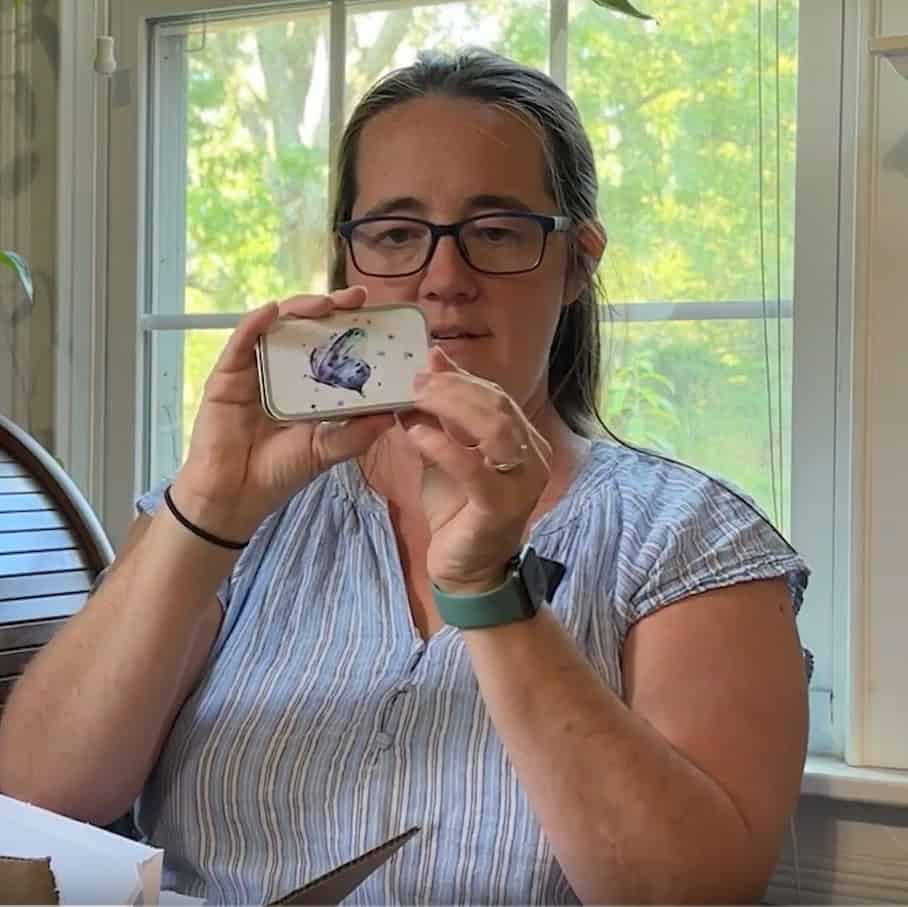
There are lots of adorable stitch markers out there. Even though I don’t often use them, I have so many cute ones. I also have this little tin to store them in. You can grab all kinds of different stitch markers and tins from Twice Sheared Sheep. Or you might also like one of these fun sets from Amazon.
5. Highlighter Tape
If you like to follow mosaic crochet charts, and you’ve ever found yourself asking, “What row am I on?” you are going to love tip number five! One crochet tool that I really like to use for reading charts is highlighter tape. Highlighter tape is a transparent tape that comes in different colors and peels off of paper really easily. It’s a great way to highlight and track where you are without damaging your chart.

To use highlighter tape, tear a piece of the tape as long as your chart. I like to make a little courtesy tab by folding over one end of the tape onto itself. That way it’s easy to grab when you’re ready to remove the tape. Then, you just place it over the row that you are working on. The highlighter tape highlights the row for you so you don’t’ lose track. When you finish the row, you can easily rip off the tape and move it to the next row. You can pick up some highlighter tape of your own up from my local yarn shop, Hook & Needle or from Amazon.
6. Row Counters & Stitch Repeat Tracker
Tip number six is another tool that will help you keep track of what row you’re on without marking on your pattern. You can use a row counter or a stitch repeat tracker of some kind. One option is this little wooden counter that I found at my local yarn store. You keep track by sliding a little bead to mark what row you’re on. And it goes all the way up to 100. Pretty fun! Grab this wooden bead counter from Hook & Needle.

Another tool for row tracking is this chain counter, which you can get from Twice Sheared Sheep. This one works kind of a stitch marker. You can place it at the beginning of your row to mark what row you are on. You can also insert your hook through the chain and carry it along with you as you work. Then, just switch the number every row.

And finally, if you’re working to a certain length, a Work Until… Measuring Tape is a great way to keep track. It’s just hangs out with you at the edge of your work so you can measure as you go. You don’t have to keep on bringing out your measuring tape. Get your own from Twice Sheared Sheep.

Clover also makes a dial-based counter that you can purchase on Amazon.
7. Anchor Stitch
Moving away from tools, number seven is using the anchor stitch. You may have noticed that when you’re doing overlay mosaic crochet, and you make a long string of front loop only double crochets, it leaves flaps in the back. In order to get rid of those flaps, you’re going to use an anchor stitch to tack down those long flaps. It’s a little special stitch where you’re going to crochet along and then just kind of grab those stitches and tack them down. Learn how to do the anchor stitch with this video crochet tutorial.

8. Fix Mistakes a Couple Rows Down
Tip number eight is not to frog your whole project if you make a mistake. This one, I’ve seen people do all too often. They’re like, “Oh, three rows down over near the end, I made a mistake. Now I’ve had to frog like three rows in order to fix it!” Wait! Don’t frog your whole project.
Instead, just loosen up the knot on that top row and pull it out, only to right above where your mistake is. Do the same for the next row or two below, just back to your mistake. Then, working your way back up, finish up each row with the correct stitches and fasten off again.

It’s really easy. You don’t have to frog the whole project. You can just frog back to where the mistake is and then fix as you go. This is one of my best time-saving mosaic crochet techniques. It’s magic. When I first realized that, I was like, “Genius!” No extensive frogging needed. I repeat, no frogging needed! Before you start ripping out your whole project, watch this tutorial to see how to fix mosaic crochet mistakes a couple rows down.
Bonus Tip: When you are fastening off at the end of each row, make sure that you leave an extra long tail so that if you miss a couple double crochets in there and then you go back to fix them, you have enough yarn to fix it.
9. Sew Over Deep Mistakes
But what if you make a mistake way far down and frogging that far would just hurt your soul? You look at your project and you realize, “Oh my gosh! I’m almost done with this this blanket, but down here at the bottom, I made a mistake. What can I do?” You don’t want to frog the whole thing, but it’s really, glaringly obvious. I get it. I’ve done this lots of times before. No judgment.
In this scenario, one of my favorite mosaic crochet techniques is to sew over the mistake. Take a little strand of the yarn of the color that you need. So maybe there needs to be a double crochet where there isn’t one. Just take a strand of that yarn of the double crochet and then just kind of weave it on there. Sew the yarn in and out and try to mimic the look of a double crochet stitch, or just covered up the part that needs to be covered up. Easy.

Again, don’t frog the thing! Just do minor surgery, and flub it, and do the best you can. Me, too. No judgment. Okay, use that trick. Want to fix a mistake way back? Try this video tutorial.
10. Pack a Project Bag
And finally, tip number 10. We all know this one because we’re crocheters, right? Pack up a little project pouch that includes your project—your yarn, your hook, maybe your yarn carousels, your stitch markers, scissors, snips, chart, pattern, row counter, whatever you may need. Just pack that all up so that when you’re on the go, you can just be crocheting wherever you are.

I always crochet at the doctor’s office. I crochet at my kids baseball games. I crochet in the pickup lines, at church. With these project pouches, you’re always going to be ready to stitch on the go. Find this project bag you see here from Twice Sheared Sheep or this one from Amazon, that has lots of fun compartments to store your yarn and different tools.
What are Your Favorite Mosaic Crochet Techniques or Tools?
There you go—my top 10 mosaic crochet tips and tricks. Do you have any go-to mosaic crochet tools or techniques that I didn’t share here? I really hope that you share them with us, either by commenting here or in the Juniper & Oakes Crochet Community on Facebook! Sharing is caring and sharing our ideas and learning from each other. Happy crocheting, friends!



Hi Erin, I have a question about the envelope border. Some designers incorporate a single crochet before the end border stitch. I, personally, see no reason for this. Isn’t a border stitch called that because you use it for the envelope border? I use the border stitch, and single crochet around in what is the front part of it and then the back part. It takes a lot of time but comes out perfectly. Is there a reason for each designer to have “their own method of doing the border”?
Thank you in advance!
Great question! 😊 Just like crocheters have different preferences for how they hold their hook or make a magic ring, designers often develop their own preferred methods for things like envelope borders. There isn’t one “right” way—many approaches can lead to a great result. You’re absolutely welcome to use the method that works best for you, and often it only takes a small tweak for a pattern to fit your preferred approach.
Thanks for sharing your experience!